

B'Robotics
Organization
Tech
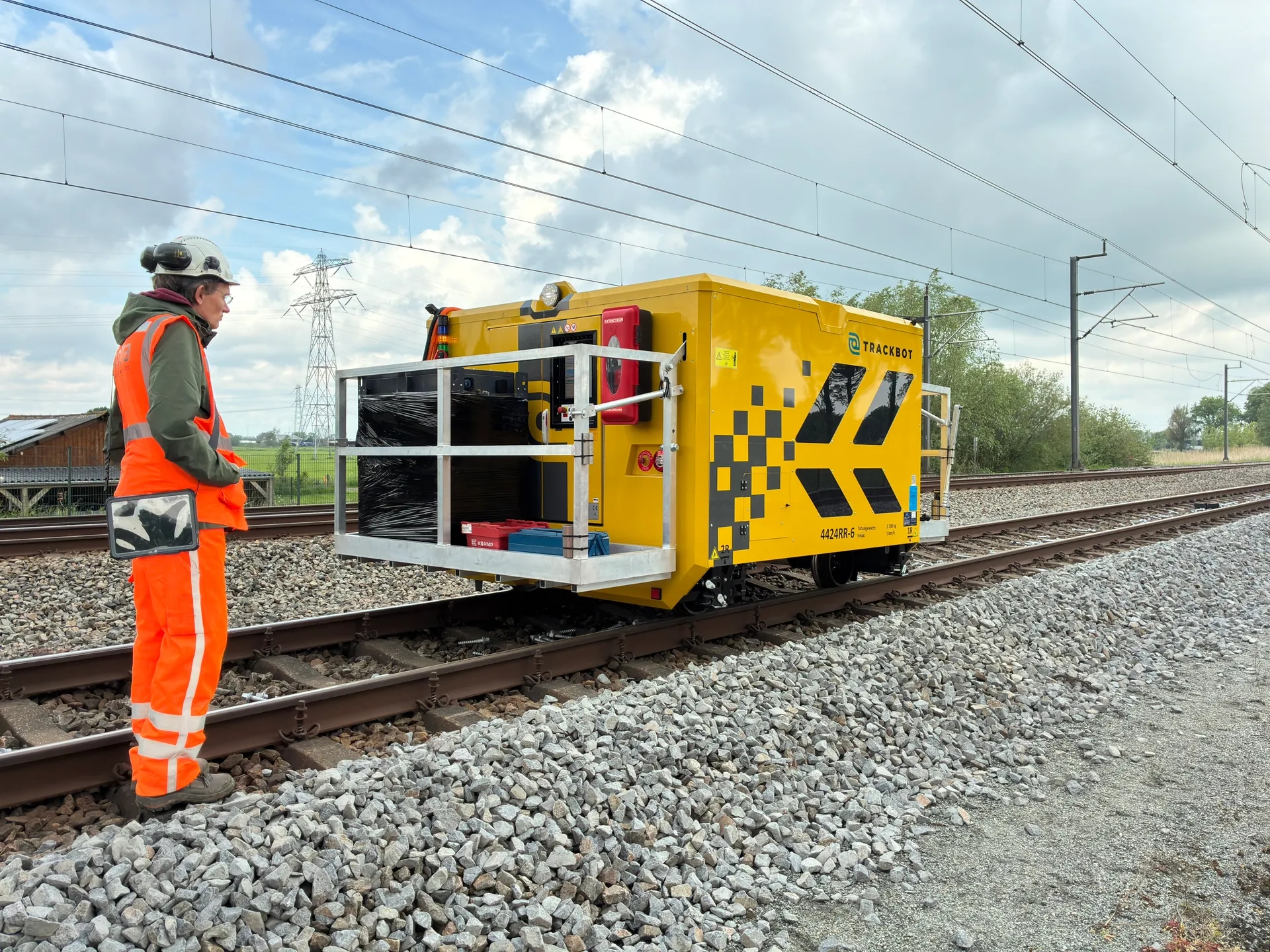
The Trackbot is essentially a robotic platform specially developed for work on and around the railway tracks. The system has a modular design, allowing it to be used for various tasks.
Using cameras and sensors, the surroundings are fully scanned, after which a digital representation of the environment is created. The Trackbot can be controlled via an online platform and is increasingly able to operate autonomously.
The reason for developing the Trackbot lies in a combination of staff shortages and the nature of the work.
“There is a lot of manual labour, while the work is also demanding and difficult to cover because of staff shortages,” Sven explains. “Railway maintenance requires continuous upkeep. Components must keep functioning and connections must be checked constantly.”
Much of this work is repetitive and therefore well suited to automation. According to Sven, the Trackbot can make a major difference in this respect. “The robot now replaces the work of three to four people.”
In addition, attitudes towards work are changing. Night shifts and irregular working hours are becoming less attractive.
“If that robot has to get out of bed for just one hour, it doesn’t mind. A person sees things differently.”
AMT came to Breda in a natural way. "To be completely honest, two of the three owners are from Breda, so the choice was quickly made," says Sven. "But Breda also provides a strong foundation for technical talent."
According to him, the city has good technical education programmes that align with companies such as AMT. "Think mechanical engineering, electrical engineering and mechatronics. At both secondary vocational and higher professional education level, because we need people who can apply technology."
The city's scale also plays a role. "The range of technical companies in Breda is slightly smaller, which makes it attractive to be based here."
In addition, Breda proved to be a logical choice in practical terms. The city is centrally located and easily accessible within Europe, which is beneficial for AMT's international customers.
The Trackbot is currently being actively deployed and further developed. “The focus is entirely on applications within the rail sector,” Sven explains. “Tasks that are often still carried out manually, such as loosening and tightening components, can increasingly be performed by the robot.”
According to him, that is only the beginning. “The Trackbot is such a flexible solution. Whereas we currently loosen and tighten screws, in the future even more tasks could be automated.”
Trackbot 2.0 has now also been developed. This version has three robotic arms and is designed for, among other things, drilling work, installing chemical anchors and fitting components for railway safety systems. In 2026, this second version was also tested in practice.
Artificial intelligence plays an important role in the development of the Trackbot, particularly in the area of image recognition.
“We use AI for visual support, whereby everything that is scanned is also actually recognised and processed,” says Sven.
As a result, the robot is becoming increasingly intelligent and can respond more effectively to situations on the railway. This represents an important step towards more autonomous systems.
AMT is also working with various partners on the development of the Trackbot. In the area of image recognition, for example, it is working with Cboost, which provides expertise in vision technology. This collaboration is helping the Trackbot to recognise and interpret its surroundings increasingly effectively.
According to Sven, the way we look at railway maintenance is changing. “The worksite we currently know on the railway is gradually moving towards a kind of assembly process, in which as much work as possible is prepared digitally in advance.”
Automation plays a key role in this. Not only for the sake of efficiency, but also because employees’ expectations are changing. People are seeking a better balance between work and private life, while the work still has to continue.
Robotisation is becoming increasingly important for cities such as Breda and for the Netherlands as a whole. “We must continue to automate, particularly in sectors where staff shortages are continuing to grow,” says Sven.
Interestingly enough, he expects residents to notice little of it. “I think it’s actually best if you don’t notice it at all,” he says with a laugh.
A great deal of work goes on behind the scenes to keep the infrastructure running. If robots can take over precisely these kinds of tasks, Sven believes this will create a more efficient and future-proof system.
Organization
26 November 2026 until 28 November 2026
Activity
Location
Article
Article